Let’s get going! Or: Why voluntary action is not enough
Contrail Avoidance has a classic market problem.
The costs arise for the airline: more planning, more complexity and, depending on the route, usually a little more fuel. In individual tests, the additional fuel burn was not significant. For scaling, however, we should still expect avoidance to mean somewhat more fuel in many cases.
The benefit arises for society: less warming.
For CO₂, there is at least a price now. Not perfect, not high enough, but it exists. Under the EU Emissions Trading System, additional CO₂ emissions cost money.
With contrails, it is different: if a flight creates a strongly warming contrail, that effect does not yet appear in the calculation in a comparable way.
This creates a strange incentive.
An airline that avoids a contrail may burn more fuel — and may therefore even pay more for fuel and CO₂. An airline that does not avoid it saves those costs, even though it may cause far more climate impact.
Or put differently: as long as harmful contrails cost nothing, avoiding them remains a voluntary add-on.
Sign the petitionThe EU has started. Now it must not stop.
Since 2025, airlines in the EU have had to monitor non-CO₂ effects. That matters.
But: for now, the obligation only applies within a reduced European scope — essentially to flights within the European ETS area and certain neighbouring connections. That means many long-haul flights, of all things, remain outside the system for now.
A missed opportunity.
Because long-haul flights in particular can be highly relevant due to altitude, duration and night-time share.
Still, the monitoring obligation is a start. But: measuring is not avoiding.
The monitoring obligation is the beginning of serious climate policy for aviation — not its conclusion. The next step has to be turning data into decisions:
- Which contrails count as particularly relevant?
- Which avoidance measures are reasonable?
- How are additional CO₂ emissions and avoided non-CO₂ effects accounted for?
- Which obligations apply to airlines?
- What role will air traffic control and European aviation authorities play?
The solution is here. Now it needs a mandate.
Contrail avoidance does not replace honest climate policy for aviation.
It does not make flying harmless. It does not solve the CO₂ problem. It does not replace rail, traffic reduction, sustainable fuels or efficiency standards.
But it addresses a huge blind spot.
According to current estimates, the climate impact of contrails is in the same order of magnitude as the CO₂ impact of all aviation to date. And a large share of that impact can be addressed comparatively quickly.
Not someday. Now.
Help move Lufthansa.
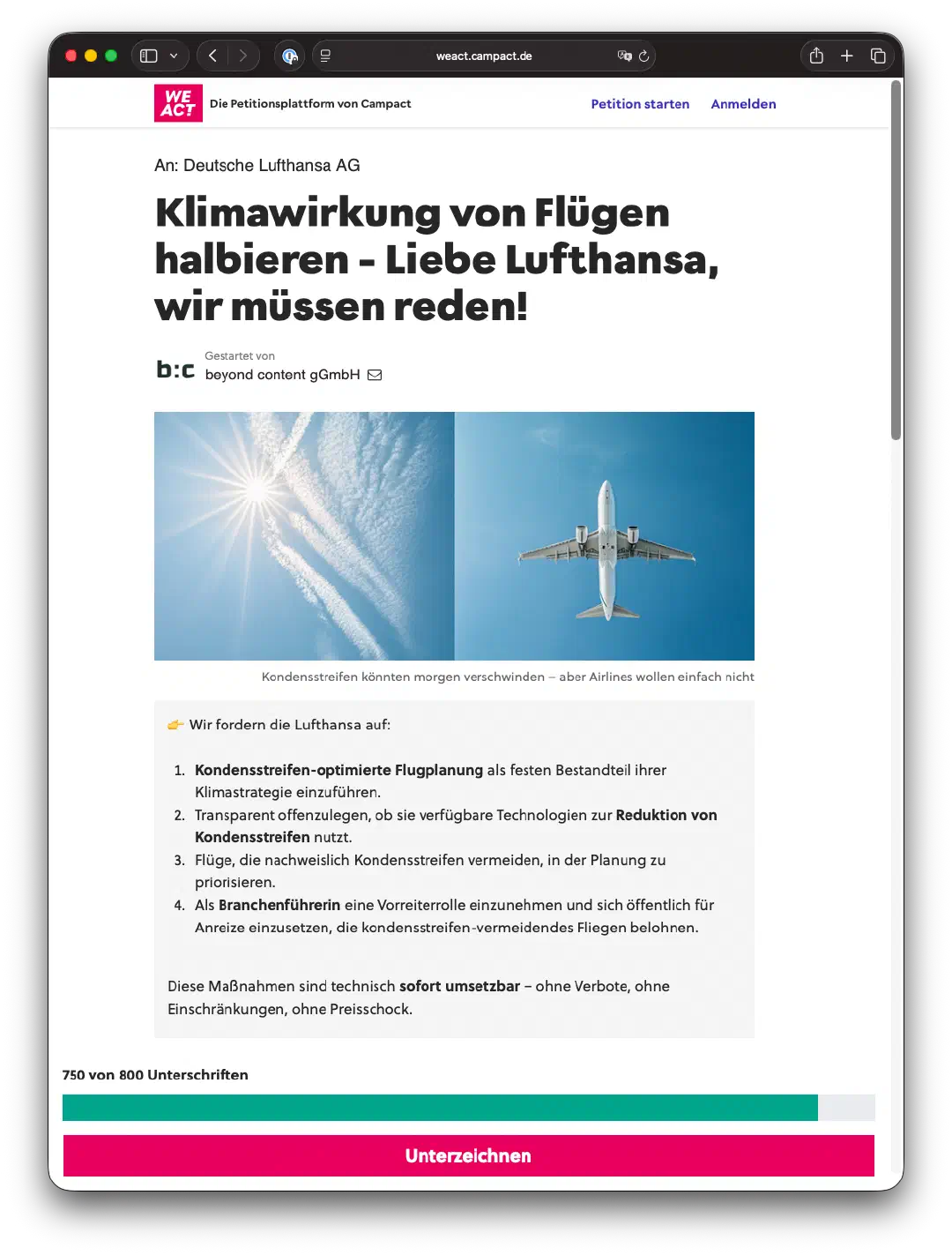
Contrail avoidance is feasible. Now it needs public pressure — specifically on the airlines that should be testing, scaling and no longer downplaying this solution politically.
That is why our petition is addressed to Lufthansa: as Germany’s largest airline, as a politically influential player in Europe and as a company that could lead on contrail avoidance.
Sign the petitionDo you work in aviation, research or flight planning?
Then join the chapter. We are looking for people who do not just agree — but can think this through with us. Join the chapter