The solution is here
This is no longer about whether contrail avoidance is possible.
It is about who finally scales it.
The research is advanced. The first field trials are running. Weather models, satellite data and routing software can now estimate where particularly climate-damaging contrails will form — and how to avoid them.
There are still uncertainties. Especially when it comes to predicting humidity at high altitude with precision. But the point is: we already know enough to act. Not acting would, in all likelihood, be the worse decision.
→ Because the solution is not: reinvent every flight. The solution is: plan a small number of highly relevant flights better.
Part of aviation’s climate impact occurs in very specific weather conditions, at very specific altitudes, on very specific routes — and at specific times of day. That is exactly what makes contrails complicated.
And exactly what makes them avoidable.
Petition unterschreiben How does Contrail Avoidance work? For professionals: join the chapter
Contrail Avoidance: what does that actually mean?
Contrail Avoidance means planning flight routes in a way that prevents long-lived, warming contrails from forming in the first place.
Not every contrail is a problem. Not every flight has to divert. And not every altitude change is worth it.
The core is a trade-off:
- Is this route likely to produce a long-lived contrail?
- How strong would its climate impact be?
- Can the flight avoid it with a small adjustment?
- And is the additional CO₂ from that adjustment clearly smaller than the avoided warming?
Only when that calculation works does avoidance make sense.
That sounds sober. It is. Contrail avoidance is not a symbolic climate gesture.
The operational core: find, avoid, verify
Contrail Avoidance consists of three building blocks.
Find: where are the critical air layers?
Long-lived contrails mainly form in so-called ice-supersaturated regions — ISSRs for short.
These are areas where the air is extremely cold and contains more moisture than it can actually hold. When an aircraft flies through them, water vapour and exhaust particles can turn into ice crystals that do not disappear immediately, but grow into artificial cirrus clouds.
These artificial cirrus clouds have a strong climate effect.
So the task is: predict where these zones are.
That requires weather models, humidity data, temperature profiles, flight routes, satellite observation and experience from real flights.
This is harder than measuring CO₂. CO₂ has a relatively uniform global effect. Contrails are local, time-dependent and weather-driven.
Avoid: small change, big impact
If a route passes through a critical zone, it can be adjusted.
Often, this means vertical changes: a little higher, a little lower. Sometimes it also means slight horizontal deviations. Above all, it means planned, controlled adjustments.
Much like aircraft already avoid weather systems, turbulence or closed airspace today. Most of the time, passengers notice nothing.
In practice, this means Contrail Avoidance has to be integrated into existing flight planning.
Not as an extra request from the climate bubble. But as an additional parameter alongside safety, weather, airspace, traffic, fuel, costs and punctuality.
Verify: did the avoidance actually work?
The third building block is crucial: measurement.
Because there is no rear-view mirror in the cockpit. Pilots cannot reliably see whether a long-lived contrail has formed behind them — and certainly not what climate impact it will later have.
Satellite data can help verify whether contrails formed on certain routes — or did not. This turns a forecast into a learning system.
Prediction. Flight decision. Observation. Improvement.
Technically, this is not trivial. Contrails have to be detected in satellite images, attributed to individual flights and compared with weather data. That requires global collaboration:
- airlines,
- research,
- software providers,
- satellite data,
- weather services,
- and air traffic control.
What the first field trials show
In 2023, Google Research and American Airlines tested targeted flight route adjustments. The result: significantly fewer persistent contrails formed on the tested routes.
The first proof of concept showed a 54 percent reduction. In a larger test with American Airlines, Google Research, Contrails.org and Flightkeys, 62 percent less contrail formation and 69 percent less associated warming were later reported.
That does not mean: problem solved. But it does mean: the direction is right.
Since then, more actors have been working on implementation and scaling: DLR, Lufthansa, TUI, Flightkeys, Contrails.org, Breakthrough Energy and others.
This is not yet full-scale operation. But it is also no longer just paper logic. It is the transition from:
“Maybe we could do this someday.”
to:
“How do we build this into real processes?”
The real challenge sits between model and cockpit
At first, the solution sounds simple: a few flights, a few hundred metres, a massive lever.
That is true. But implementation is not a magic button.
For Contrail Avoidance to work reliably, three operational blocks in particular have to work together:
Flight planning
This is where routes are created. This is where weather data, fuel, costs, punctuality, routing software and climate metrics come together. And this is where it is decided whether non-CO₂ effects appear as a relevant factor at all — or continue to disappear into the small print.

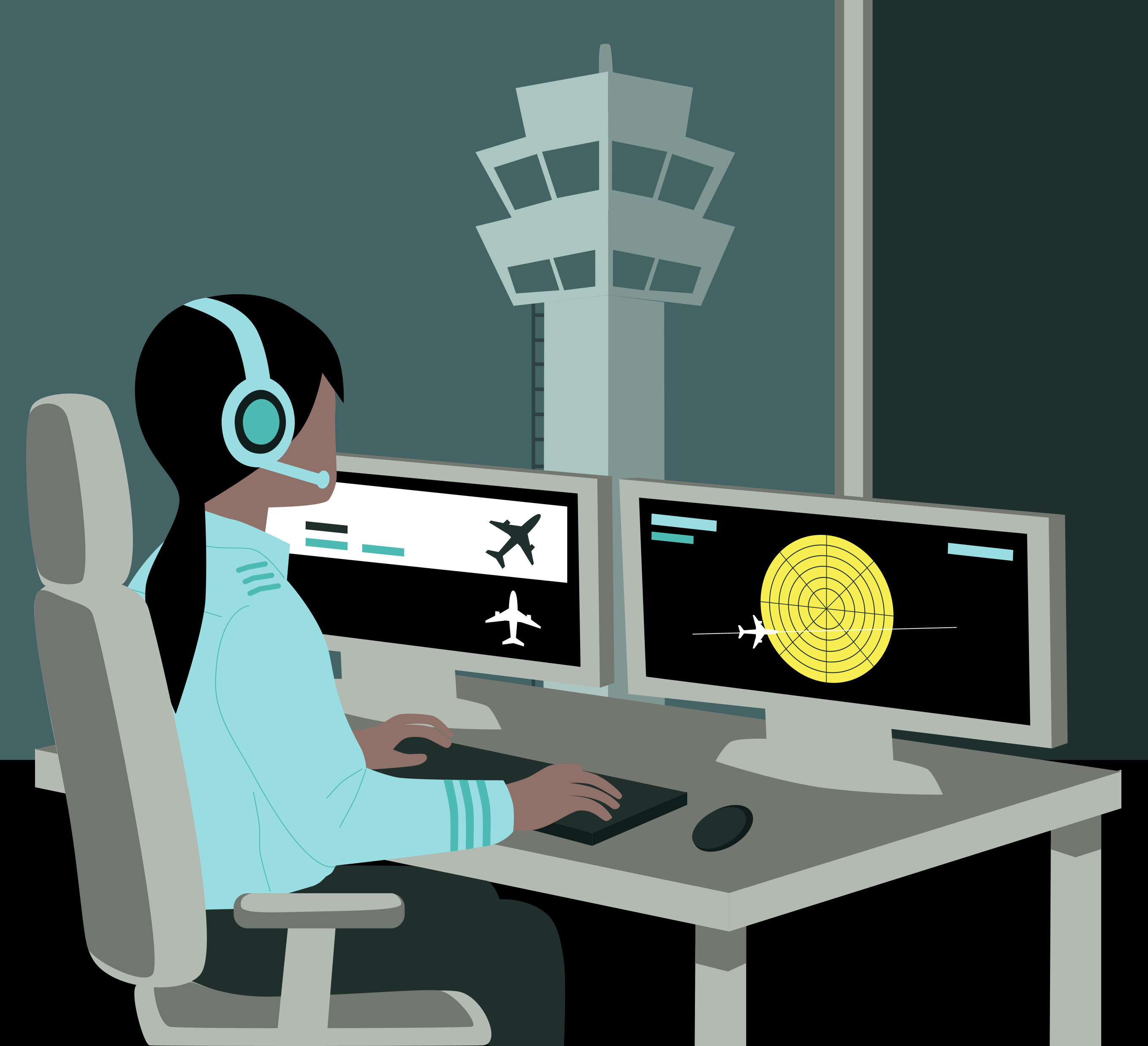
Air traffic control
Even the best avoidance route remains theory if it does not fit into real airspace. Sectors have capacity limits. Altitude changes need clearance. Traffic conflicts have to be avoided. Safety always remains more important than climate optimisation.
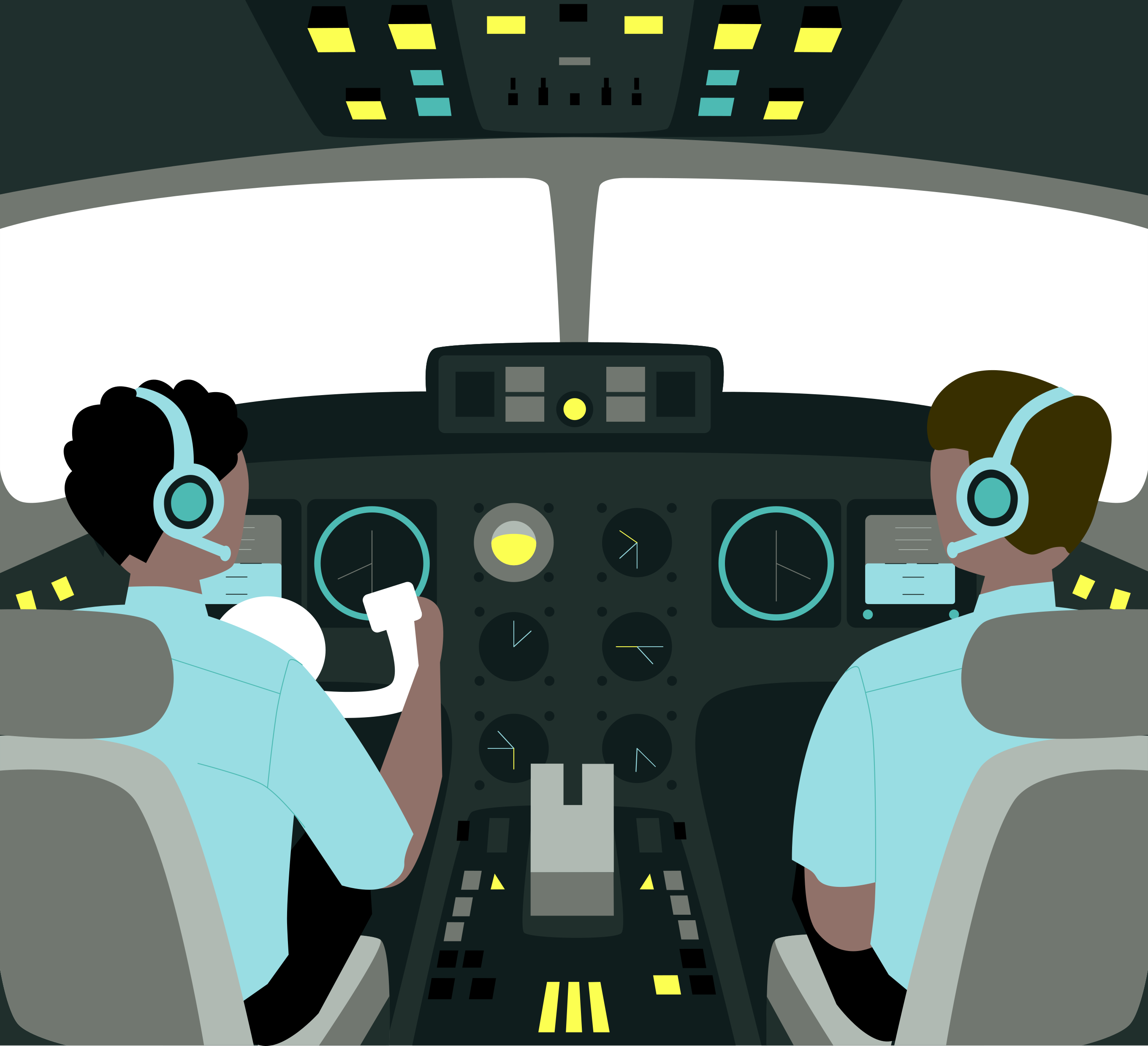
Pilots
In the cockpit, instructions need to be clear, safe and practicable. No spontaneous climate improvisation at cruising altitude. Instead: well-prepared procedures, understandable alternatives and as little additional workload as possible.
Each of these levels has its own constraints.
A flight cannot simply change altitude whenever it feels like it. Airspaces can be full. Weather forecasts are uncertain. Routes need clearance. And safety always remains more important than climate optimisation.
That is why the industry is needed. Not as an opponent. But as a co-developer.
The big strength: we can measure impact
Many climate promises in aviation are hard to grasp. Contrail avoidance is different.
It intervenes directly in current flight operations. It uses existing aircraft. It does not require a new global fuel infrastructure. And its impact can, at least partly, be verified using satellite data.
That does not make it perfect. But it makes it unusually concrete.
What does implementation really cost?
The short answer: surprisingly little.
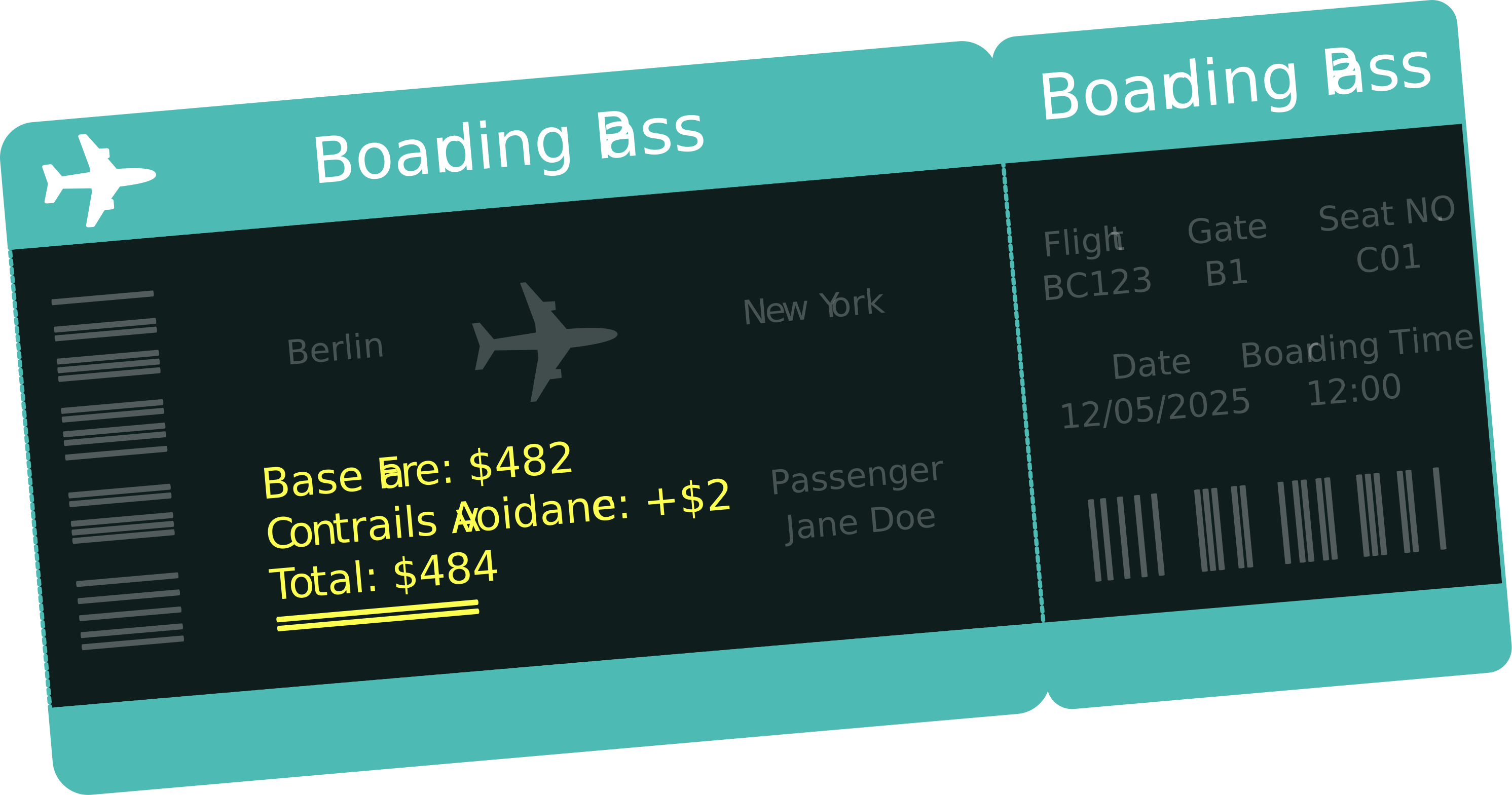
estimates the cost of targeted contrail avoidance at roughly 20 US dollars per flight — not per ticket. Per avoided tonne of CO₂ equivalent, the order of magnitude is around 1 to 2 US dollars.
In a European analysis, Transport & Environment estimates additional ticket costs of around 1.60 euros for an intra-European flight and about 4.30 euros for a transatlantic flight.
So: less than a coffee at the airport.
Important: these are averages and modelling results. The actual costs depend on which flights avoid, how large the adjustment is, how full the airspace is, how expensive fuel is and which technology is used for measurement and forecasting.
But the direction is clear: compared with many other aviation climate measures, Contrail Avoidance is very cheap.